Publications

This page is a selection, not a complete bibliography. It holds my five most recent publications, my co-edited book, a book chapter and an UpToDate article, and some of my most-cited papers. Each entry has a short note on what the paper did. The complete record, which includes 70+ peer-reviewed publications, is in my publication list (PDF) and on Google Scholar and ORCiD.

Recent publications

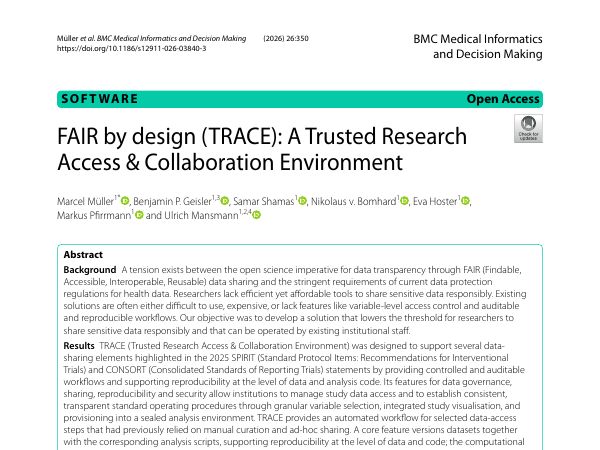
Top of the first page of FAIR by design (TRACE): A Trusted Research Access & Collaboration Environment

FAIR by design (TRACE): A Trusted Research Access & Collaboration Environment

BMC Medical Informatics and Decision Making · September 2026

A description of TRACE, a platform built at LMU Munich for sharing sensitive study data under control. Applicants select the variables they need, access is approved and logged, and the analysis runs in a sealed environment with data and code versioned together. It has handled 56 data access applications across seven clinical studies. Whether it shortens the time from request to analysis has not been measured.

Müller M, Geisler BP, Shamas S, von Bomhard N, Hoster E, Pfirrmann M, Mansmann U (2026). "FAIR by design (TRACE): A Trusted Research Access & Collaboration Environment." BMC Med Inform Decis Mak. doi:10.1186/s12911-026-03840-3
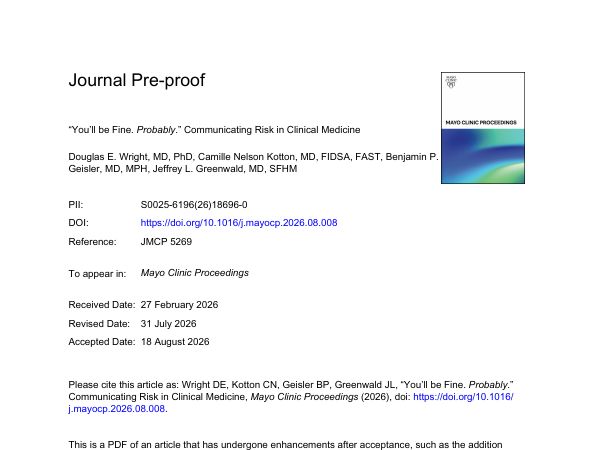
Top of the first page of "You'll be Fine. Probably." Communicating Risk in Clinical Medicine

"You'll be Fine. Probably." Communicating Risk in Clinical Medicine

Mayo Clinic Proceedings · August 2026

A review of why clinicians and patients so often talk past each other about risk, from vague words like “rare” to limited numeracy and the pull of emotion, ending in a practical framework (RISKS) for having those conversations better.

Wright DE, Kotton CN, Geisler BP, Greenwald JL. “You’ll be Fine. Probably.” Communicating Risk in Clinical Medicine. Mayo Clin Proc. 2026.

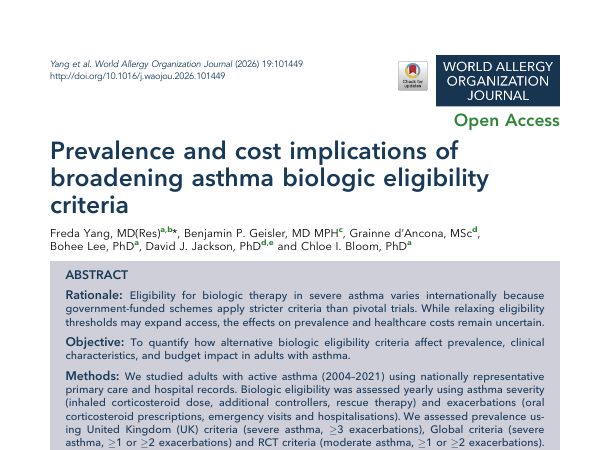
Top of the first page of Prevalence and cost implications of broadening asthma biologic eligibility criteria

Prevalence and cost implications of broadening asthma biologic eligibility criteria

World Allergy Organization Journal · August 2026

How many more adults would qualify for asthma biologics if the eligibility criteria were widened, and what that would cost. In UK records of 1.3 million people with asthma, 1.5% were eligible under current UK criteria and up to 9% under the criteria of the pivotal trials. The modeled five-year cost rose from £261 million to as much as £1.6 billion. Where the eligibility line is drawn largely sets the budget.

Yang F, Geisler BP, d’Ancona G, Lee B, Jackson DJ, Bloom CI (2026). "Prevalence and cost implications of broadening asthma biologic eligibility criteria." World Allergy Organ J. doi:10.1016/j.waojou.2026.101449

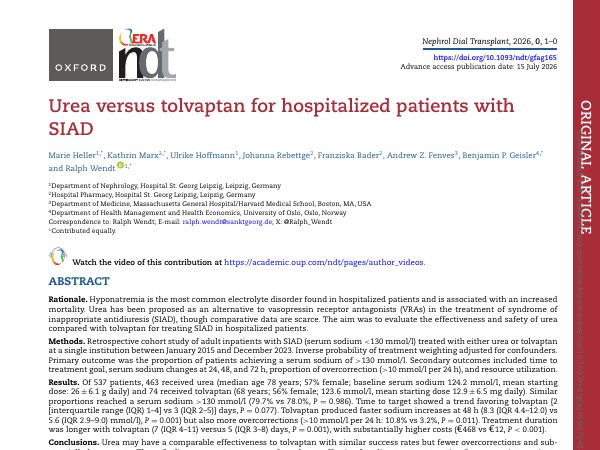
Top of the first page of Urea versus tolvaptan for hospitalized patients with SIAD

Urea versus tolvaptan for hospitalized patients with SIAD

Nephrology Dialysis Transplantation · July 2026

A retrospective cohort study of 537 inpatients with the syndrome of inappropriate antidiuresis (SIAD) at one German hospital, 463 treated with urea and 74 with tolvaptan. Similar proportions reached the sodium target. Tolvaptan raised sodium faster but overcorrected more often and cost far more (€468 versus €12). The groups were not randomized, so the comparison rests on statistical adjustment. The study follows our 2023 systematic review of urea for the same condition.

Heller M, Marx K, Hoffmann U, Rebettge J, Bader F, Fenves AZ, Geisler BP, Wendt R (2026). "Urea versus tolvaptan for hospitalized patients with SIAD." Nephrol Dial Transplant. doi:10.1093/ndt/gfag165

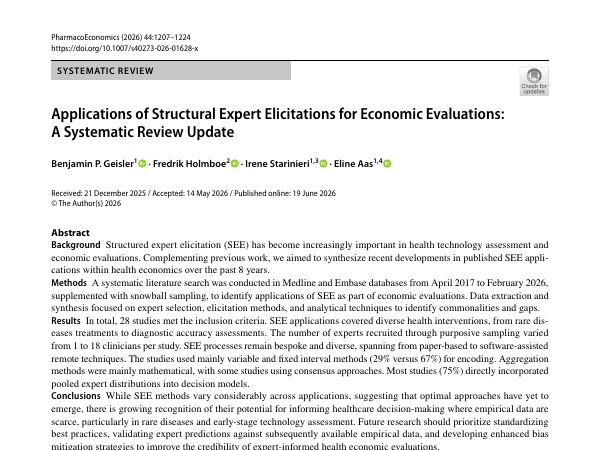
Top of the first page of Applications of structural expert elicitations for economic evaluations: a systematic review update

Applications of structural expert elicitations for economic evaluations: a systematic review update

PharmacoEconomics · June 2026

A systematic review of how structured expert elicitation has been used in economic evaluations since 2017. Elicitation means asking experts, by a formal protocol, to put numbers and uncertainty on quantities for which data are scarce, as is common in rare diseases and early technology assessment. Across 28 studies the methods were still bespoke, with 1 to 18 experts per study and no agreed best practice. This was a side project during my PhD at the University of Oslo.

Geisler BP, Holmboe F, Starinieri I, Aas E (2026). "Applications of Structural Expert Elicitations for Economic Evaluations: A Systematic Review Update." Pharmacoeconomics. doi:10.1007/s40273-026-01628-x

Book chapters and edited volume

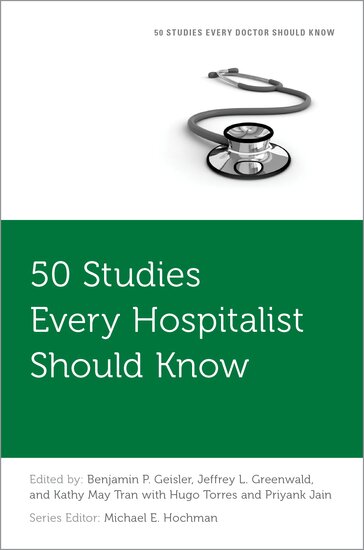
Cover of 50 Studies Every Hospitalist Should Know

50 Studies Every Hospitalist Should Know

Oxford University Press, New York · 2026

A co-edited volume in the 50 Studies Every Doctor Should Know series. Each chapter takes one landmark study in hospital medicine and sets out what it asked, what it found, and what it does and does not settle at the bedside. It grew out of years of teaching residents at Massachusetts General Hospital and Harvard Medical School.

Geisler BP, Greenwald JL, Tran KM, editors. 50 Studies Every Hospitalist Should Know. New York: Oxford University Press; 2026.

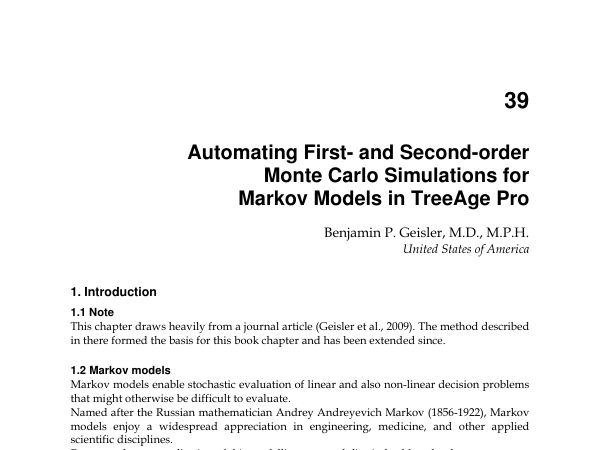
Top of the first page of Automating First- and Second-order Monte Carlo Simulations for Markov Models in TreeAge Pro

Automating First- and Second-order Monte Carlo Simulations for Markov Models in TreeAge Pro

Applications of Monte Carlo Method in Science and Engineering · February 2011

A practical chapter on Markov models in health technology assessment, showing how to automate first- and second-order Monte Carlo simulation in TreeAge Pro. It extends the scripting approach from a technical note I published in Value in Health in 2009.

Geisler BP (2011). "Automating First- and Second-order Monte Carlo Simulations for Markov Models in TreeAge Pro." In: Mordechai S, editor. Applications of Monte Carlo Method in Science and Engineering. Rijeka, Croatia: InTech. doi:10.5772/15065

Top of the first page of Psychogenic Purpura (Gardner-Diamond Syndrome)

Psychogenic Purpura (Gardner-Diamond Syndrome)

UpToDate · 2007

A topic review for UpToDate, a clinical reference used at the point of care, on a rare and poorly understood syndrome of painful bruising that tends to appear at times of stress. I wrote it in 2007 and have kept it updated since.

Geisler BP. Psychogenic Purpura (Gardner-Diamond Syndrome). In: Leung LLK, Tirnauer JS, editors. UpToDate. Wellesley, MA: UpToDate; 2007-.

Other selected publications

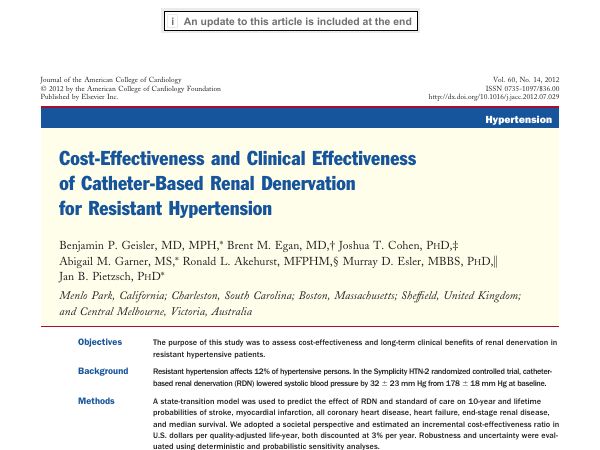
Top of the first page of Cost-effectiveness and clinical effectiveness of catheter-based renal denervation for resistant hypertension

Cost-effectiveness and clinical effectiveness of catheter-based renal denervation for resistant hypertension

Journal of the American College of Cardiology · September 2012

My most cited paper. An early economic evaluation of renal denervation for high blood pressure that resists drug treatment. A state-transition model projected strokes, heart attacks, heart failure, kidney failure and costs over ten years and over a lifetime, and found the procedure cost-effective. The blood pressure effect came from the open-label Symplicity HTN-2 trial. Later sham-controlled trials found smaller reductions, so the result holds only as far as that input does.

Geisler BP, Egan BM, Cohen JT, Garner AM, Akehurst RL, Esler MD, Pietzsch JB (2012). "Cost-Effectiveness and Clinical Effectiveness of Catheter-Based Renal Denervation for Resistant Hypertension." J Am Coll Cardiol 60(14):1271-1277. doi:10.1016/j.jacc.2012.07.029

Top of the first page of Meniscus root repair vs meniscectomy or nonoperative management to prevent knee osteoarthritis after medial meniscus root tears

Meniscus root repair vs meniscectomy or nonoperative management to prevent knee osteoarthritis after medial meniscus root tears

The American Journal of Sports Medicine · March 2018

A meta-analysis and Markov model comparing repair, meniscectomy and nonoperative management of medial meniscus root tears in 55-year-old patients. Over ten years, repair was projected to lead to less osteoarthritis and fewer knee replacements than either alternative, at lower cost. The inputs came from the published literature, not from head-to-head trials, which the paper calls for.

Faucett SC, Geisler BP, Chahla J, Krych AJ, Kurzweil PR, Garner AM, Liu S, LaPrade RF, Pietzsch JB (2018). "Meniscus Root Repair vs Meniscectomy or Nonoperative Management to Prevent Knee Osteoarthritis After Medial Meniscus Root Tears: Clinical and Economic Effectiveness." Am J Sports Med. doi:10.1177/0363546518755754

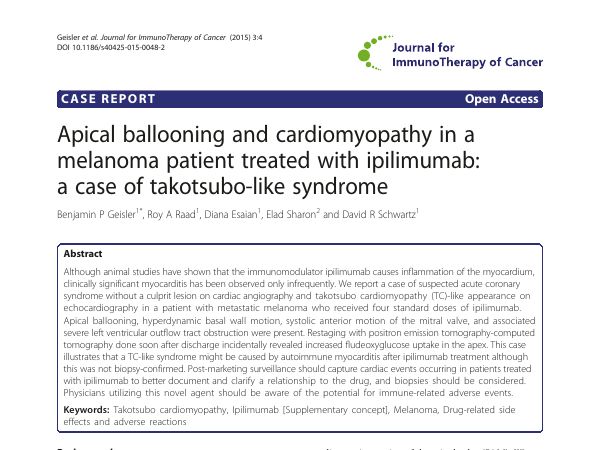
Top of the first page of Apical ballooning and cardiomyopathy in a melanoma patient treated with ipilimumab: a case of takotsubo-like syndrome

Apical ballooning and cardiomyopathy in a melanoma patient treated with ipilimumab: a case of takotsubo-like syndrome

Journal for ImmunoTherapy of Cancer · February 2015

A case report of takotsubo-like cardiomyopathy in a melanoma patient treated with ipilimumab, published in 2015, when cardiac side effects of immune checkpoint inhibitors were rarely reported. We suspected autoimmune myocarditis, though it was not confirmed by biopsy. I was later a collaborator in an international registry report on 261 patients with suspected checkpoint inhibitor myocarditis who underwent coronary angiography.

Geisler BP, Raad RA, Esaian D, Sharon E, Schwartz DR (2015). "Apical ballooning and cardiomyopathy in a melanoma patient treated with ipilimumab: a case of takotsubo-like syndrome." J Immunother Cancer 3:4. doi:10.1186/s40425-015-0048-2

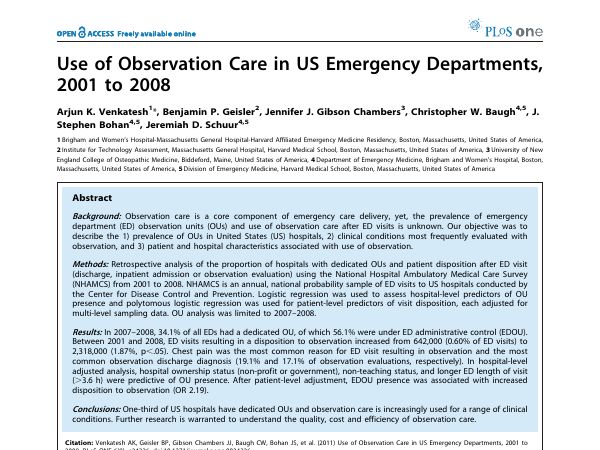
Top of the first page of Use of observation care in US emergency departments, 2001 to 2008

Use of observation care in US emergency departments, 2001 to 2008

PLOS ONE · September 2011

A national picture, from a federal survey of emergency department visits, of how often US emergency departments placed patients under observation instead of admitting or discharging them. Such visits rose from about 640,000 in 2001 to 2.3 million in 2008, and by 2007–2008 one third of emergency departments had a dedicated observation unit.

Venkatesh AK, Geisler BP, Gibson Chambers JJ, Baugh CW, Bohan JS, Schuur JD (2011). "Use of Observation Care in US Emergency Departments, 2001 to 2008." PLoS One 6(9):e24326. doi:10.1371/journal.pone.0024326

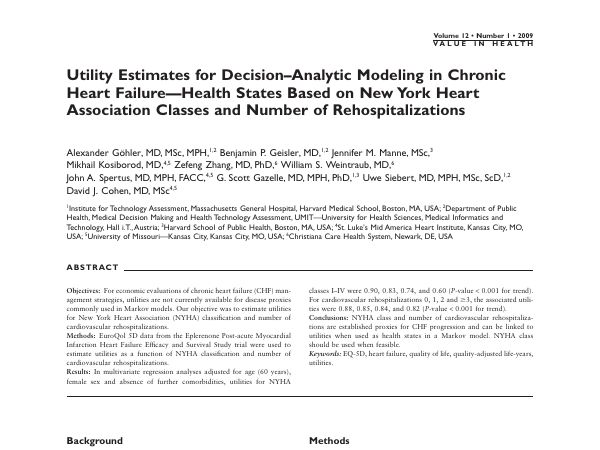
Top of the first page of Utility estimates for decision-analytic modeling in chronic heart failure

Utility estimates for decision-analytic modeling in chronic heart failure

Value in Health · July 2008

Quality-of-life weights (utilities) for heart failure health states defined by New York Heart Association class and by number of rehospitalizations, estimated from EQ-5D data collected in the EPHESUS trial. Cost-effectiveness models need such numbers as inputs, and the paper was written to supply them.

Göhler A, Geisler BP, Manne JM, Kosiborod M, Zhang Z, Weintraub WS, Spertus JA, Gazelle GS, Siebert U, Cohen DJ (2008). "Utility Estimates for Decision-Analytic Modeling in Chronic Heart Failure—Health States Based on New York Heart Association Classes and Number of Rehospitalizations." Value Health. doi:10.1111/j.1524-4733.2008.00425.x

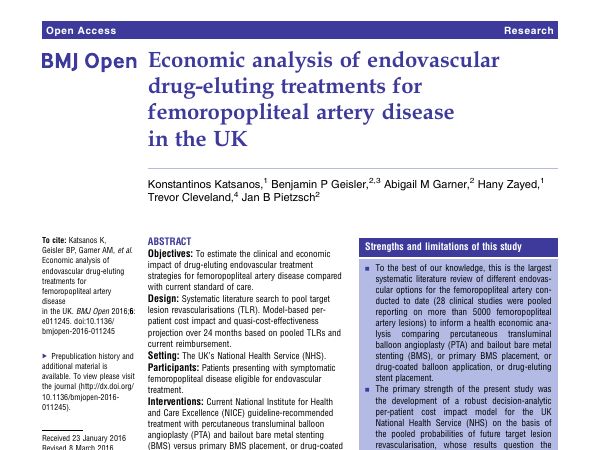
Top of the first page of Economic analysis of endovascular drug-eluting treatments for femoropopliteal artery disease in the UK

Economic analysis of endovascular drug-eluting treatments for femoropopliteal artery disease in the UK

BMJ Open · May 2016

Whether drug-coated balloons and drug-eluting stents for femoropopliteal artery disease justify their higher price by reducing repeat procedures, from the perspective of the UK National Health Service. In a model fed by pooled results from 28 studies, both roughly halved repeat procedures over 24 months at an added cost of about £44 per patient.

Katsanos K, Geisler BP, Garner AM, Zayed H, Cleveland T, Pietzsch JB (2016). "Economic analysis of endovascular drug-eluting treatments for femoropopliteal artery disease in the UK." BMJ Open 6(5):e011245. doi:10.1136/bmjopen-2016-011245

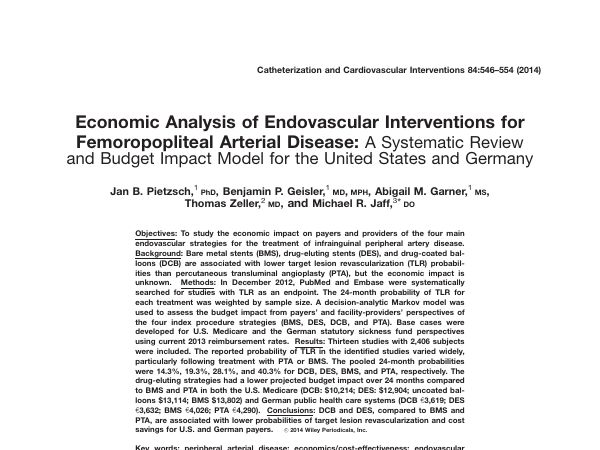
Top of the first page of Economic analysis of endovascular interventions for femoropopliteal arterial disease: a systematic review and budget impact model for the United States and Germany

Economic analysis of endovascular interventions for femoropopliteal arterial disease: a systematic review and budget impact model for the United States and Germany

Catheterization and Cardiovascular Interventions · April 2014

A systematic review of repeat-procedure rates after four endovascular treatments for femoropopliteal artery disease, feeding a budget impact model run for both US Medicare and the German statutory health insurance. Over 24 months, drug-coated balloons and drug-eluting stents were projected to cost payers less than bare metal stents or plain balloon angioplasty. It is one of several analyses I have worked on that ask the same question for more than one health system.

Pietzsch JB, Geisler BP, Garner AM, Zeller T, Jaff MR (2014). "Economic analysis of endovascular interventions for femoropopliteal arterial disease: A systematic review and budget impact model for the United States and Germany." Catheter Cardiovasc Interv 84(4):546-554. doi:10.1002/ccd.25536

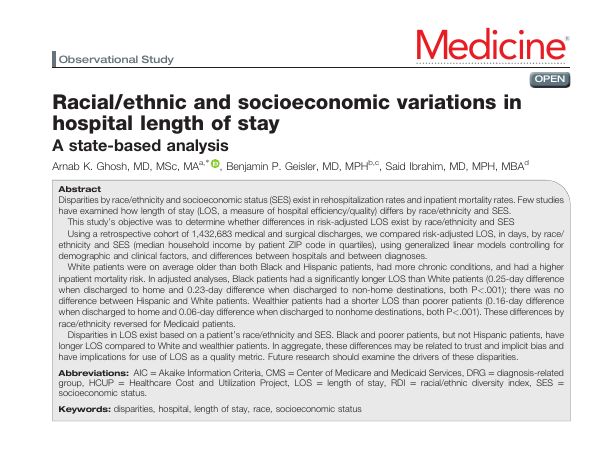
Top of the first page of Racial/ethnic and socioeconomic variations in hospital length of stay

Racial/ethnic and socioeconomic variations in hospital length of stay

Medicine · May 2021

Whether hospital length of stay differs by race, ethnicity or socioeconomic position after adjusting for diagnosis, hospital and clinical factors, in 1.4 million discharges in New York State. Black patients and patients from poorer areas stayed slightly longer than White and wealthier patients. Hispanic patients did not. Hospitals treat length of stay as an efficiency measure, which makes such differences worth understanding.

Ghosh AK, Geisler BP, Ibrahim S (2021). "Racial/ethnic and socioeconomic variations in hospital length of stay." Medicine (Baltimore) 100(20):e25976. doi:10.1097/md.0000000000025976

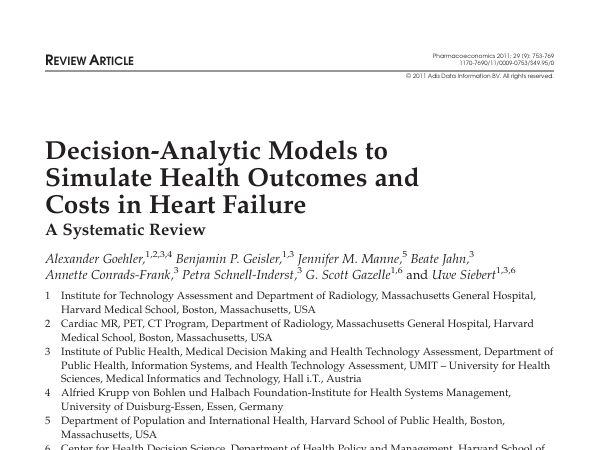
Top of the first page of Decision-analytic models to simulate health outcomes and costs in heart failure: a systematic review

Decision-analytic models to simulate health outcomes and costs in heart failure: a systematic review

PharmacoEconomics · May 2011

A systematic review of 34 decision-analytic models of heart failure, describing how each represented the disease and where the approaches differed. Most relied on New York Heart Association class or hospitalizations as a proxy for disease progression, the two proxies for which our 2008 utilities paper supplies values. Reviewing modeling practice, as opposed to clinical evidence, is something I came back to in the 2026 review of structured expert elicitation.

Goehler A, Geisler BP, Manne JM, Jahn B, Conrads-Frank A, Schnell-Inderst P, Gazelle GS, Siebert U (2011). "Decision-Analytic Models to Simulate Health Outcomes and Costs in Heart Failure: A Systematic Review." Pharmacoeconomics 29(9):753-769. doi:10.2165/11585990-000000000-00000